
NEBAW
SECOND CALL FOR PROPOSALS UNDER INCENTICE PROGRAM 4
(Aug 2024 to Aug 2027)
NEBAW is a project included in the Second Call for Proposals under Incentive Program 4: Basic and Fundamental Research Challenges, Innovative Pilots, and Training in Key Enabling Technologies within the incentive programs for the innovative value chain and knowledge of renewable hydrogen, under the “Recovery, Transformation, and Resilience Plan – Funded by the European Union – NextGenerationEU,” managed by IDAE.
NEBAW is a platform for the decentralized production of hydrogen WITHOUT AN EXTERNAL WATER SUPPLY, using atmospheric moisture capture. To achieve this goal, among others, the platform features a new advanced electrolyzer developed by Advanced Thermal Devices (ATD).
The electrolyzer developed by ATD is based on non-PGM catalysts and optimized membranes, which significantly reduce energy consumption (efficiency) and costs compared to conventional electrolysis, making the overall energy balance—including moisture recovery from the air—comparable to a system with an external water supply. Its modular design and direct integration with renewable energy sources facilitate autonomous, scalable operation that is adaptable to various application environments.
As a RESULT, the aim is to ELIMINATE the need for external water supply while maintaining current efficiency standards, which significantly helps minimize the impact of H₂ production via electrolysis on water resources.
For more information, see the following link:
HIDRAM
CDTI MISIONES-2022 (MIP-2022-1014).
(Oct 2022 to Dec 2024)
The HIDRAM Project has the purpose of building a complete demonstration setup including the key elements for the decarbonization of the maritime transport. Innovate technologies are developed, related to the hydrogen and ammonia value chain and to enhance the R&D capacity of the Spanish industry in this matter, covering the entire production process. The Key Parameters of the HIDRAM Project include:
Ammonia Synthesis, catalyst based with less than 14 kWh/kg NH3 energy consumption (H2 generation included).
PEMFC for maritime use. H2 fuel extracted from ammonia (NH3 cracker and H2 purification with less than 1 ppm of NH3). Combined efficiency greater than 30% (35% optimistic case).
The project includes a complete engineering model for system integration on ships and ports, according to legal normative (IMO and European Rules).
It would be a pioneering demonstrator in Europe for green hydrogen and ammonia as decarbonization fuels for maritime transportation.
Consortium partners: Astilleros de Mallorca, Astilleros F. Cardama, ATD, JALVASUB Engineering, VENTOR Innovations and SOERMAR, with scientific collaborators: ICV-CSIC, UNED and Fundación CIUDAUT
For more information, see the following link:
ZEROeVTOL
PROGRAMA TECNOLOGICO AERONAUTICO 2022. PTAP-20221017
(Oct 2022 to Dec 2024)
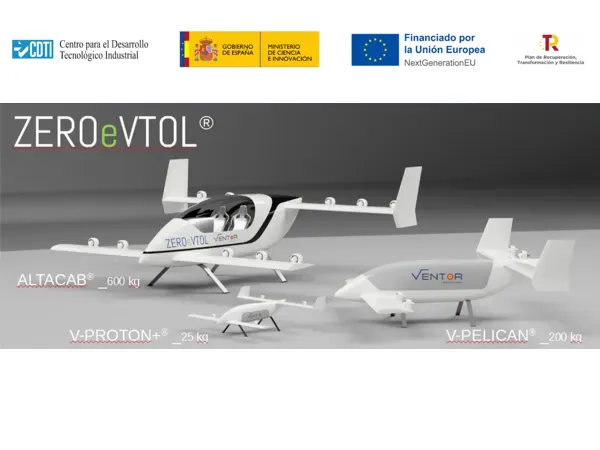
This project has as target to design and to build two unmanned aircraft (UAV or drone, as they are commonly known) propelled by a Fuel Cell powered by H2. In this way, work will be carried out on two lines of innovation within the framework of the PTA: a new type of convertible aircraft, which takes off and lands vertically, like a helicopter, and has wings for cruise flights, like an airplane; and a propulsion system without carbon dioxide emissions or other gases harmful to the environment. In addition, an experimental direct ammonia SOFC-H was developed to evaluate H2 and NH3 as fuel for Fuel Cells considering issues and advantages for both cases.
Consortium partners: SOLUTE, VENTOR Innovations, JALVASUB Engineering, and ATD with scientific collaborators: ICV-CSIC, UNED and Fundación CIUDAUT.

ALTERA
CDTI MISIONES-2020 (MIP-2020-1003).
(oct-2020 to jun-2023)
Storage of electrical energy as thermal energy.
Electrical energy is transformed into thermal energy through microwaves using special absorbing materials such as silicon carbide, reaching a temperature of 1414ºC corresponding to the fusion of silicon. The thermal energy is confined through mirrors with very high reflectance throughout the infrared spectrum (more than 99.9%). This fact allows this thermal energy to be available during 10 to 100 hours with very low losses. By means of thermo-photovoltaic cells (TPV) it is possible to convert the energy radiated by the hot spot into electricity again, so the system acts as a battery with very high capacity, long life and low losses.
Electrical energy is transformed into thermal energy by microwaves using SiC susceptors designed to contain fused Si.
Consortium partners: ESTEYCO, SILBAT, GFM, NANO4ENERGY and ATD. with scientific collaborators: ICV-CSIC and IES-ETSIT (UPM).
SSTEC
CDTI IDI-20171255
(2017 to 2018)
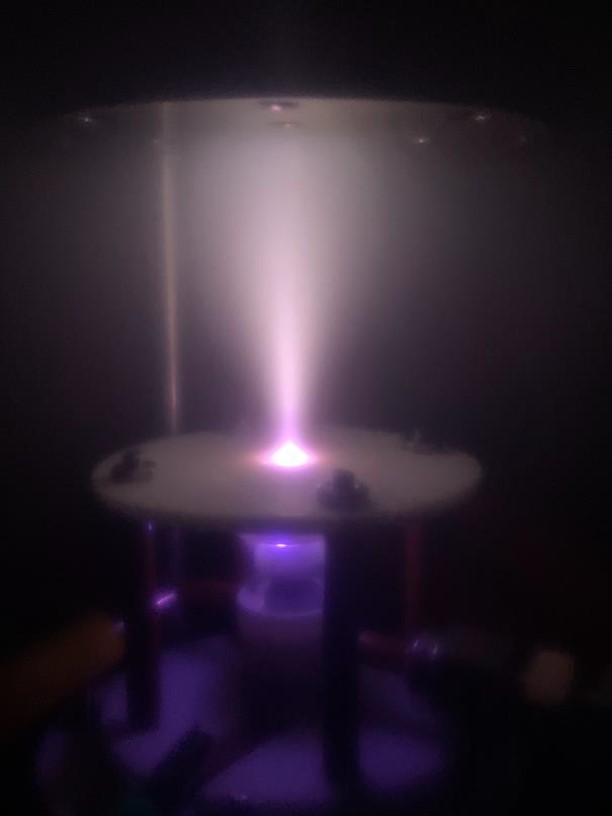
Development of the first thermionic emission devices based on C12A7:e– material (electride) that will lead to aerospace applications such as neutralizers for ionic thrusters, used in further European projects (NEMESIS) and other applications (E.T.PACK).

THERMIONICS
Advanced Thermo-ionic Emission Devices
CDTI IDI-20151237
(2015 to 2016)
Start of the synthesis and successful production of the C12A7:e– material (electride) as a very low work function material for electron emission by means of thermal energy.